Bread Crumbs

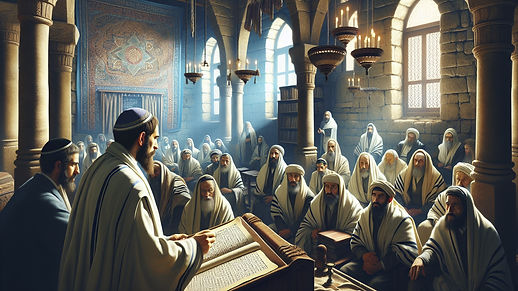
While I will be starting a new series through the “Daily Slice” within the next few days, I wanted to write a “Bread Crumb” as an introduction to this series. The series will cover the qualifications for a congregational leader, as outlined in 1Timothy chapter 3, a subject that is well worth the look. Being as how these instructions were written by Rabbi Sha’ul (Apostle Paul), I would not be incorrect in saying that this man knew what he was talking about.
This topic has been churning around inside of me for a while now, which means (in my experience) that Abba Yah has something to say. The subject is “accountability in leadership”, an uncomfortable one for many folks. However, in my research, I find that it IS a scriptural principal, meaning that it is found in the words of Torah. For those of you who read my writings, you know that I always try to give the Word, THE Word, the WORD. It is always the final authority. Therefore, let us look at the Scriptures first.
Most of us are familiar with the passage of Scripture found in Exodus chapter 18, where Yithro, the father-in-law of Moshe, admonishes him to appoint leaders and rulers under him, under his authority. Should you compare the list of qualifications, you would see the similarities between these passages from Exodus, and the passages from 1Timothy. Sha’ul KNEW Torah.
Exo 18:21 “But you yourself, seek out from all the people able men, who fear Elohim, men of truth, hating unfair gain. And place these OVER THEM to be rulers of thousands, rulers of hundreds, rulers of fifties, and rulers of tens. (emphasis mine)
Exo 18:22 “And they shall rightly rule the people at all times. And it shall be that they bring every great matter to you, but they themselves rightly rule every small matter. So, make it lighter for yourself, for they shall bear with you.
This principle was again confirmed in Deuteronomy the first chapter (verse 15). Yes, this had to do with legislation and judgment, but please remember that there was no separation of church and state, it was all one. So these leaders who would arbitrate would also teach and inform the folks for whom they were responsible. This is also where the birth of the “minyan” came from[1].
Further studies revealed that Melech David left instructions to organize the Levitical priesthood into groups, with each group having different responsibilities. One group may have been in charge of inspecting for leprosy (a duty of the priests, Lev 13:9), another may have been in charge of the gates of the Hěḵal (Temple, see 2Chro 8:14), another group would have the duty of teaching Torah, as they still do today in the local congregations. And another set of Levites would have the authority to pass judgement - a “Beit Din” (see Deu 16:18)[2]. All of these mentioned have someone that they were accountable TO: from the verses in Exodus, the leaders chosen were to answer to Moshe in all things. Each group of Levites had a chosen leader, and this leader was answerable to the Beit Din, or the Kohen Gadol (High Priest). No excuses.
We have an example of a ‘council of elders’, found in the Book of Acts, which is an account of Sha’ul’s travels, and how the Word of Elohim was spread. In Acts 18:18, we learn that Sha’ul took the vow of a Notzri (Nazarene), and shaved his head. We also learn that he was determined to keep one of the commanded feast days at Jerusalem (speculation is Shavuot, see Acts 20:16), and that was his focus. Sha’ul met with the Apostolic council of elders upon arrival in Jerusalem, and related to them what all had been happening through his ministry. Because of persecution from many of the Jews present in the city for the feast, the elders recommended Paul, with four (4) others fulfill the Notzri vow, as spelled out in Torah (see Num 6, also Acts 21:20-26). Again, this is Sha’ul, a Pharisee and a learned man of Torah, submitting to the instructions of the Apostolic council of elders. Sha’ul was NOT a ‘Lone Ranger’.
Our Elohim is a God of order; He brough order out of chaos and turmoil when He spoke the Word, and our world was formed. We all have a place, or a position we are to occupy, and flourish in (Rom 12:4-5). Those who function outside of the order that our Master has set in place, those who refuse to be accountable, responsible, answerable, or subject to authority – in any shape or form – are in rebellion, in opposition to Torah.
We see this in our civil society, where there is structure and order. Those who consistently break the laws of our land will end up in court, and suffer punishment. As an example, from the laws we have governing our roads and highways, there are those listed that involve speed limits. People who continually break traffic laws will most likely end up with a suspended license as a result. Another example involves illegal immigrants: the mass migration of people who have entered the United States illegally are now being caught and deported, some with no option to immigrate to this country legally. For every cause, there is an effect; for every crime committed, there is a punishment.
Let us now take a look at what I call the “Westernized Church System”. There are several denominations that have grasped the importance of accountability, especially in leadership, and their rules and regulations reveal this. A local pastor or shepherd is answerable to the ruling council of that particular denomination – a biblical principle. While I am not in favor of the council telling the local man of God what he may or may not preach/teach, the fact that he has a “chain of command” is right.
My apprehension is with the bunch that call themselves “non-denominational”. First, there is an over-abundance of self-appointed, self-proclaimed, self-installed, self-taught, and self-anointed ministers that have no business being part of the ministry. Ezekiel chapter 34 has severe warnings against self-proclaimed ministers who are not faithful to tend and care for the flock that Elohim has given them. Read this chapter, if it has been a while since you have done so.
Second, this is not exclusive to the Westernized Church System – it is now becoming common among Messianic communities. Leaders are no longer accountable to anyone, for anything that they might say or do. There is no one who has the rule over them, and many insist they are the standard with which we are to compare others to. And again, they are self-appointed and self-installed, while answering to no one.
We learned (in the biblical ‘kindergarten’) of the servant’s heart of our Messiah, who came to serve, not to be served (Mar 10:45). From this we also have learned that in order to be a successful leader, we must first learn to serve, and if necessary ‘wash the feet of the disciples’. Until we have been as nothing but a humble servant, Elohim will never promote someone to a place with any form of authority. We must first be faithful in the little, to be ruler over much (see Parable of the Talents, Mat 25:14-29).
I do not believe that we should compromise on what we understand is Elohim’s pattern for local congregations. There MUST be someone who is in authority over all, usually an outside council of elders. This includes the local shepherd being under said authority. And it is imperative that this leader be one that has been appointed and anointed by those who would be over him in the ministry. Otherwise, I strongly believe that without this authority, it is a recipe for disaster. My admonition to all, brothers and sisters, is to be careful of whose feet you are sitting under. You would not wish to be stomped into the dirt.
©2025
[1] A minyan is a quorum of ten Jewish adults – in traditional Orthodox communities, ten males, and in more progressive communities, ten people – required to recite specific public prayers and for other religious purposes. The Talmud derives this concept from the story of the spies and elsewhere mentions the books of Ruth and Psalms as sources of the requirement for a minyan in particular circumstances.


Comments